Lyrikzeitung & Poetry News
Das Archiv der Lyriknachrichten | Seit 2001 | News that stays news
107. But some men in Badakhshan
Documentary about Afghan woman poet by Rahmat Haidari and Sajia Hussain
106. Balls Messgesang
Hugo Ball (1886-1927) begründete während des Ersten Weltkriegs in Zürich den Dadaismus. (Hatte er nicht wenigstens einen Koch bei sich?)
Anja Kampmann sprach im Deutschlandfunk über
Wiebke-Marie Stock: „Denkumsturz Hugo Ball. Eine intellektuelle Biografie“ Wallstein Verlag
Aber bereits im Juni 1916, in der Hochphase der Dada-Zeit, entdeckt Wiebke-Marie Stock eine Dimension der Klanggedichte, die Ball fortan beschäftigen wird. Während er in einem Bischofskostüm aus Glanzpapier ein Krippenspiel aufführt, fällt ihm plötzlich etwas auf. Seine Stimme
„verfällt bei der Aufführung in die uralte Kadenz der priesterlichen Lamentation, in ‚jenen Stil des Messgesangs, wie er durch die katholischen Kirchen des Morgen- und Abendlandes wehklagt. Ich weiß nicht, was mir diese Musik eingab.“
Ball erblickt inmitten seiner Wort- und Vokalalchemie eine plötzlich aufscheinende religiöse Dimension.
105. Poets‘ Picks
Poets‘ Picks feature for Poetry Month:
Sign up for a free subscription to our newsletter!
Our free weekly e-mail newsletter alerts you to upcoming featured poets, news from the world of poetry, and special events like this one: again this year for Poetry Month and our annual April fund drive, we’ve asked 22 poets (including Jessica Greenbaum, Alpay Ulku, Tina Chang, and Lloyd Schwartz) to select poems to be delivered to you by e-mail Monday through Friday of each week in April — their favorites from among The Greats — along with their comments on the poems.
Sign up now (and tell your friends-in-poetry) before you miss our special April poems! (Note: if you already receive our weekly e-newsletter, you need not sign up again). / Poetry Daily
104. Schönschreiben
Im Japanischen kann man Gedichte nicht nur lesen und rezitieren, man kann sie auch anschauen und schönschreiben. Letzteres wird als Kunst so hoch geachtet wie das Dichten.Kurz nach der Katastrophe schrieb Yoko Ono während eines Vortrag über die Katastrophe das Zeichen für ‚Traum‘ auf eine Leinwand. Einer Kalligrafin beim Schönschreiben zuzuschauen, gilt as besonderes Kunsterlebnis. Japan hat seine Schriftzeichen von China übernommen, auch die Kalligrafie als Kunst. Trotz des Streits um einige Felsen im Meer, die zum Abbruch mancher Kulturkontakte führten, zeigt das Nationalmuseum zur Zeit Kalligrafien des chinesischen Meisters Wang Xizhi aus dem vierten Jahrhundert. / Süddeutsche Zeitung 16.3.
Nachrichten aus Japan von Christoph Neidhart, s.a. Hundert Tanka / Wiederaufbau- Lied
103. American Life in Poetry: Column 412
BY TED KOOSER, U.S. POET LAUREATE
Mark Sanders, who lives in Texas, is not only a good poet, but he’s an old friend to the poetry of my home ground, working hard as teacher, editor, and publisher to bring Great Plains poetry to the attention of readers across the country. Here’s an example of one of his poems.
The Cranes, Texas January
I call my wife outdoors to have her listen,
to turn her ears upward, beyond the cloud-veiled
sky where the moon dances thin light,
to tell her, “Don’t hear the cars on the freeway—
it’s not the truck-rumble. It is and is not
the sirens.” She stands there, on deck
a rocking boat, wanting to please the captain
who would have her hear the inaudible.
Her eyes, so blue the day sky is envious,
fix blackly on me, her mouth poised on question
like a stone. But, she hears, after all.
…………………………………………… January on the Gulf,
warm wind washing over us,
we stand chilled in the winter of those voices.
American Life in Poetry is made possible by The Poetry Foundation (www.poetryfoundation.org), publisher of Poetry magazine. It is also supported by the Department of English at the University of Nebraska-Lincoln. Poem copyright ©2011 by Mark Sanders from his most recent book of poems, Conditions of Grace: New and Selected Poems, Stephen F. Austin State University Press, 2011. Poem reprinted by permission of Mark Sanders and the publisher. Introduction copyright © 2013 by The Poetry Foundation. The introduction’s author, Ted Kooser, served as United States Poet Laureate Consultant in Poetry to the Library of Congress from 2004-2006. We do not accept unsolicited manuscripts.
102. Anglophon
Welcher Reichtum. Allein heute haben Geburtstag: A.E. Housman, Robert Frost, Tennessee Williams und Gregory Corso.
Hier ein Gedicht von Housman:
The Carpenter’s Son
„Here the hangman stops his cart:
Now the best of friends must part.
Fare you well, for ill fare I:
Live, lads, and I will die.
„Oh, at home had I but stayed
‚Prenticed to my father’s trade,
Had I stuck to plane and adze,
I had not been lost, my lads.
„Then I might have built perhaps
Gallows-trees for other chaps,
Never dangled on my own,
Had I left but ill alone.
„Now, you see, they hang me high,
And the people passing by
Stop to shake their fists and curse;
So ‚tis come from ill to worse.
„Here hang I, and right and left
Two poor fellows hang for theft:
All the same’s the luck we prove,
Though the midmost hangs for love.
„Comrades all, that stand and gaze,
Walk henceforth in other ways;
See my neck and save your own:
Comrades all, leave ill alone.
„Make some day a decent end,
Shrewder fellows than your friend.
Fare you well, for ill fare I:
Live lads, and I will die.“
Alfred Edward Housman
101. Auf der Suche nach einem verlorenen (Griechen)Land
»Sogar dann, wenn jeder Himmel fehlt …«
Auf der Suche nach einem verlorenen (Griechen)Land
Zusammengestellt von Asteris und Ina Kutulas
die horen. Zeitschrift für Literatur, Kunst und Kritik (Hg. von Jürgen Krätzer); Bd. 58. Jahrgang, 249
€ 14,00 (D) | € 14,40 (A) | SFr 19,50
Gedichte von Jazra Khaleed, Konstantin Kavafis (Unfertige Gedichte), Maria Poliduri, Kostas Karyotakis, Giorgis Seferis, Jannis Ritsos, Menelaos Ludemis, Tasos Livaditis, Takis Sinopoulos, Jakovos Kambanellis, Manolis Anagnostakis, Rena Chatzidaki, Titos Patrikios, Nikos Engonopoulos, Dionisis Karatzas, Sakis Serefas, Lefteris Poulios, Antonis Fostieris, Thanassis Lambrou, Kiki Dimoula
Prosa von Konstantin Kavafis (Reisetagebücher), Mikis Theodorakis, Odysseas Elytis
Eine Rose, die Poesie wird, kann dich brutaler niederstrecken als eine Faust, die niemals Poesie werden kann. Myriaden von Worten welken in rot eingebundenen Büchern, kaum dass ein Mädelchen einen Schuss abgibt.
Aris Fioretos, Amanda Michalopoulou u.a.
(fast alle Texte Erstübertragungen)
100. Non-written poems
Early experimental poetry from (communist) Czechoslovakia:
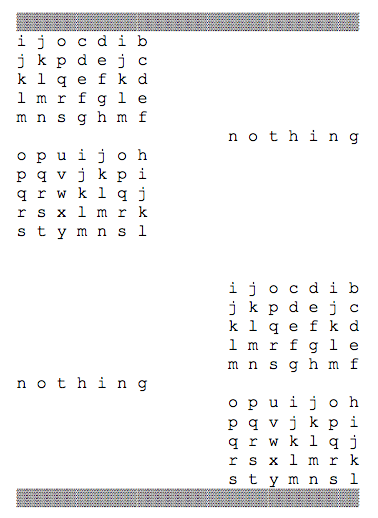
The following set of „Non-Written“ poems includes an introduction to the process of creating this type of poetry:
Nebeský wonders if his early binary poems were ahead of their time. Certainly many circumstances of his life and in the world during the period after the creative upsurge of the 1960s were not conducive to their full development. The invasion of Chechoslovakia in 1968 suppressed some of the artistic flowering of the mid 1960s, but it’s not wise to see declines in creativity solely in political or other simplistic terms.
The world of the present may be more cordial, and Nebeský’s personal circumstances greatly improved. The world, after all, now depends completely on binary mediation, and much of society would collapse without the digital infrastructure that has grown since the 1960s. It is a pleasant irony to put binary poems on the world wide web, which is brought to you by binary systems. The dictatorships of the left and the right in the 1960s and 70s saw art forms such as Nebeský’s as self-indulgent, an affront to the „people“ and a decadent waste of time and energy by aesthetes. At present, binary communication is not only highly practical and engrained in the fabric of daily life for a large portion of the world’s population, the technology seems poised on the edge of bringing about a revolution that could empower many people or could become a tool of oppression. If it does the latter, the best way to resist it would include understanding it and finding it familiar.
Ladislav Nebeský was born in 1937, at Jilemnice, a small town about 100 km north-east of Prague. Begining in 1939, his father was a member of the underground anti-Nazi movement. In 1940, he was arrested by the Gestapo; in 1942, he was killed in Berlin. Ladislav Nebeský spent his first 18 years in Jilemnice. In the period 1955 – 1960 , he studied mathematics at Charles University in Prague. In 1962, he began working as a researcher at Charles University. This lead to full-time teaching at that school, where he became an Associate Professor in mathematics. The present academic year will be his last year there. He lives with his wife in Prague. They have one son, David.
The development of his poetry falls into two major periods: 1964 – 1972 and 1995 – … (Beginning in the seventies, he pursued mathematics more intensively). In the first period, he was a member of a free group of Czech authors of experimental poetry; he had many contacts with other poets. In the second period, the contacts with other writers became rather rare. In the earlier period, one of the high points for him and several other Czech poets was inclusion in the exhibition Poesía Concreta International in Mexico City, 1966. Another high point was the Konkrete Poesie exhibition, Stedelijk Museum, Amsterdam, 1970. Some of his early poetry was published in international magazines, and he is particularly pleased with one published in Ovum 10, Montevideo, Uruguay, in 1970.
99. Barocker Dichterstreit
Das ist selten geworden, seit auch die Übersetzer in deutschen Landen darauf schauen müssen, dass der übersetzte Autor sich auch verkauft. Einfach aus Spaß an der Freud‘ übersetzen, weil man ein Stück Literatur faszinierend findet, das ist nur noch den echten Exoten der Branche möglich. Einem wie Buchmann zum Beispiel.* (…)
Denn Marino war einer der bestechendsten Vertreter der artifiziellen Dichtung des italienischen Barock. „Schwülstig“, meint die deutsche Wikipedia, weil die deutschen Nachahmer schwülstig waren. Aber wer die Texte, die Buchmann ausgewählt hat, liest, findet nicht wirklich Schwulst, nur eine ausgefeilte Raffinesse, die das Spiel mit Wendungen und Bildern liebt, die den Gegner im Vergleich lächerlich macht, mit spitzen Sottisen durchbohrt und vor einem gebildeten Publikum mit fast teuflischer Lust beleidigt.
Das scheint nur halb funktioniert zu haben, auch wenn die „Murtoleide“ durchaus als Teil des sowieso schon scharfzüngigen Werkes von Marino gelesen wurde. Aber Dichterfehden haben ihre eigenen Gesetze. Und das Publikum dieser Zeit, in der es noch keine italienischen Talkshows und Telenovelas gab, hatte ganz gewiss auch ihren Spaß an den trivialen Versen Mùrtolas. Von denen Buchmann nicht ganz so viele übersetzt hat. Sie wirken auch heute primitiv. Da spielt keiner, da tanzt keiner einen spöttischen Maskenreigen – Mùrtola kommt gleich zur Sache, ruft seinen Widersacher auf den Kampfplatz und überschüttet ihn dann mit Beleidigungen aller Art. / Ralf Julke, Leipziger Internet-Zeitung
Episteln und Pistolen
Jürgen Buchmann; Giambattista Marino; Gaspare Mùrtola, Verlag Reinecke & Voß 2013, 9,00 Euro
*) Stimmt alles. Aber man soll auch darauf hinweisen, daß er einen Verleger dafür fand.
98. Poetry Foundation Celebrates National Poetry Month
Free issues of Poetry, new educational resources, Record-a-Poem, and more
CHICAGO —The Poetry Foundation is pleased to announce an exciting array of literary programs and poetry events across the country in celebration of National Poetry Month, April 2013.
Poetry
Fifty thousand free copies of Poetry’s April 2013 issue will be distributed to individuals, classrooms, and reading groups around the world in celebration of National Poetry Month. In the April issue, readers find new poetry from Eavan Boland, Jane Hirshfield, Jamaal May, Dean Young, as well as poems by Adam Kirsch inspired by accompanying photographs. In a commemorative installment of “A Few More Don’ts”—one hundred years after Ezra Pound’s original “A Few Don’ts by an Imagiste” appeared in Poetry’s March 1913 issue—William Logan, Marjorie Perloff, and Sina Queyras offer their own guidelines for poets. Readers can find the entire April issue of Poetry online as of April 1, along with the accompanying discussion guide and the magazine podcast. A downloadable PDF of the April issue is also available, perfect for laptops, tablets, or e-readers.
Harriet Monroe Poetry Institute
The Poetry Foundation’s Harriet Monroe Poetry Institute has partnered with McSweeney’s to publish two new titles for readers, writers, teachers, and travelers. In an effort to bring the joy of poetry to students, Open the Door: How to Excite Young People About Poetry, edited by Dorothea Lasky, Dominic Luxford, and Jesse Nathan, offers essays, interviews, and lesson plans. The Strangest of Theatres: Poets Writing Across Borders, edited by Jared Hawkley, Susan Rich, and Brian Turner, explores how poets can serve as international envoys and revitalize American poetry in the process. These books will be released on April 9, 2013, and are currently available on the Harriet Monroe Poetry Institute website, along with a range of free educational resources.
Record-a-Poem
Anyone can record and share their favorite poems through the Poetry Foundation’s Record-a-Poem project. Participants choose poems from the more than 10,000 available through the Poetry Foundation, then record and post them to the Record-a-Poem group on Soundcloud. Learn more about the project.
97. Mit Lyrik gegen die Krise in Ungarn
Wider die rhetorische Verwilderung – mit Lyrik gegen die Krise in Ungarn
Es war ein Gedicht, das die Ungarn aufrüttelte: István Keménys „Abschiedsbrief“ aus dem Jahr 2011 bewegte Bevölkerung und literarische Szene gleichermaßen. Das Gedicht veränderte das Verhältnis von Dichtung und Politik: der politische Diskurs in Ungarn findet jetzt über und mit Poesie statt – ein in Europa wohl einzigartiges Phänomen. Am 9.6.2013 widmet sich das poesiefestival berlin in Lesung, Gespräch und Konzert der Krise in Ungarn und der Rolle der Poesie in ihr. Mit dabei in der Akademie der Künste sind u.a. die Autoren Szilárd Borbély, István Kemény, Petra Szőcs und Péter Závada, der Performance-Künstler Tibor Szemző und der Singer-Songwriter Zoltán Beck.
Die politische Rhetorik in Ungarn ist verhärtet, die Lyrik bietet einen Freiraum zur Debatte. Poesie-Lesungen sind politischer und radikaler geworden, bei Demonstrationen werden Gedichte auf Handzetteln verteilt, bissige Aphorismen und prägnante Couplets werden getwittert und gepostet.
In dem Gedicht „Abschiedsbrief“ nahm Kemény Abschied von einem Land, das nach dem Ende des Staatssozialismus keine demokratische Stabilität gefunden hat und stattdessen zunehmend autoritäre Züge annimmt. Immer wieder hinterfragt er die Rolle des Dichters in diesen Zeiten. Szilárd Borbély trauert in seiner Lyrik über die ermordeten Roma. Ein Politikum, denn die Pogrome der Neo-Nazis werden nach wie vor nicht öffentlich diskutiert. Der Singer-Songwriter Zoltán Beck verbindet Musik und Dichtkunst und eröffnet ihr so weitere Verbreitungskanäle – in Ungarn wird wieder erlebt, was das gedichtete Wort vermag.
Das poesiefestival berlin ist ein Projekt der Literaturwerkstatt Berlin in Kooperation mit der Akademie der Künste und wird gefördert durch den Hauptstadtkulturfonds.
7.- 15. Juni 2013
14. poesiefestival berlin
Akademie der Künste, Hanseatenweg 10, 10557 Berlin
So 9.6.2013, 18.00 Uhr
Warum und wie ist die zeitgenössische Lyrik politisch?
Poesiegespräch mit Szilárd Borbély (Autor, Debrecen), Orsolya Kalász (Autorin, Berlin), Dóra Péczely (Lektorin, Budapest)
Moderation: Wilhelm Droste (Literaturwissenschaftler, Ungarn)
So 9.6.2013, 20.00 Uhr
„Die Ruinen sind genauso wie die Rose“
Zweisprachige Lyriklesung mit Szilárd Borbély, István Kemény, Petra Szőcs, Péter Závada und Singer-Songwriter Zoltán Beck
Moderation: Can Togay, Leiter des Collegium Hungaricum Berlin
So 9.6.2013, 22.00 Uhr
Multimedia-Performance: „Tractatus“
Eine Kammerkomposition zu Ludwig Wittgensteins „Tractatus Logico-Philosophicus“ von Tibor Szemző
So 9.6.2013, 23.00 Uhr
Konzert: Presszó Tangó Libidó
Die Literaturwerkstatt Berlin führt eine Kampagne zur Gründung eines Deutschen Zentrums für Poesie. Dieses Poesiezentrum wird Informations-, Arbeits-, Begegnungs- und Veranstaltungsstätte für Dichterinnen und Dichter sein, für die interessierte Öffentlichkeit aller Altersstufen, für Verleger, für Lernende und Lehrende, für Medien und Multiplikatoren aus dem In- und Ausland. Weitere Informationen unter www.poesiezentrum.de
Für Rückfragen und Informationen:
Boris Nitzsche & Jutta Büchter Presse/ÖA,
Literaturwerkstatt Berlin, Tel: 030. 48 52 45 25
www.literaturwerkstatt.org
96. Hitleristin
Bis heute ist Miegel, die nach dem Zweiten Weltkrieg in der Stadt wohnte, Ehrenbürgerin des Ortes. Im Kurpark steht ein Denkmal, das an sie erinnert und an dem auch immer wieder Neonazis Kränze niederlegen. Bereits ein kurzer Blick auf Miegels Aktivitäten und Veröffentlichungen offenbart, wieso die heutigen Rechten sie verehren.
Miegel war NS-Funktionärin und Hitleristin. 1879 in Königsberg geboren, fiel sie zunächst als nationalkonservativen Heimatdichterin auf und wurde später zur glühenden Verehrerin Hitlers. Bereits im Oktober 1933 unterzeichnete sie mit anderen systemkonformen Schriftstellern ein »Gelöbnis treuester Gefolgschaft« zu Adolf Hitler. In einem Brief an den NS-Kulturpolitiker Hans Friedrich Blunck bekannte Miegel im Folgejahr ausdrücklich: »Ich bin Nationalsozialist.« Ihrem »Führer« widmete sie in der Folge auch ihre Lyrik: »Laß in deine Hand, Führer, uns vor aller Welt bekennen.« 1937 war Miegel der NS-Frauenschaft beigetreten, drei Jahre später der NSDAP. Auch für den Bund Deutscher Mädel griff sie zur Feder. »Ich traue auf Gott und den Führer, nicht so kindlich-bequem, wie viele es tun, sondern so, wie man als Deutscher und Ostgermane dem Schicksal vertraut«, schrieb sie an Blunck. / Tobias Korn, Jungle World
95. R. S. Thomas
Klingende Namen waren es, die am 28. März 2001 die Gedenkfeier für den im Herbst des Vorjahrs verstorbenen walisischen Dichter R. S. Thomas in der Westminster Abbey bestritten. Der irische Nobelpreisträger Seamus Heaney. Andrew Motion, damals britischer Poet Laureate. Der schottische Lyriker und Romancier John Burnside, der in den letzten Jahren auch das hiesige Lesepublikum erobert hat. Und natürlich eine profilierte Stimme aus der Heimatregion des Verstorbenen, die Dichterin und Literaturvermittlerin Gillian Clarke. Ein würdiges Aufgebot für einen der Grossen in der britischen Literaturlandschaft des 20. Jahrhunderts – auch wenn R. S. Thomas sein Leben konsequent fernab der Öffentlichkeit geführt hatte. (…)
In seiner Verurteilung dessen, was er als materialistische, entseelte Moderne sah, konnte Thomas – der keineswegs zur literarischen Selbstinszenierung neigte – auch einmal das Gewand und den apodiktischen Ton des Apostels annehmen: «Und ich, Thomas, sah den Verfall / zum Bösen. Die alten, schlechten Gewohnheiten / wurden neu erlernt. Männer vermieteten ihr / Gewissen; Frauen wurden hart, schrill.» / Angela Schader, NZZ
Romane, so R. S. Thomas in «Sozusagen», seien lediglich «zum Vertagen der Wahrheit», zum Füllen der leeren Seiten, zum allmählichen Ausmalen der einmal entworfenen Figuren gut, während das Gedicht in einem Wimpernschlag alles zu fassen vermag: «Das Buch schliesst, wo die Poesie beginnt.»
R. S. Thomas: In zierlichen Schlingen. Gedichte, englisch/deutsch. Herausgegeben, übersetzt und mit einem Nachwort versehen von Kevin Perryman. Babel-Verlag, Fuchstal 2012. 84 S., € 24.–. Sonderdruck mit Originalradierung von Vroni Schwegler € 164.
94. Platonica
Der 1890 in Marburg/Lahn geborene und nach einem wechselvollen Lebenslauf 1956 auf Rhodos verstorbene Essayist, Literaturübersetzer und Ethnologe Helmut von den Steinen ist einer breiteren literarischen Öffentlichkeit heute vor allem durch seine Übertragungen aus dem Neugriechischen bekannt. So hat etwa seine Ausgabe der Gedichte von Konstantinos Kavafis geradezu klassischen Status erlangt und gilt bis in die Gegenwart als „außerordentliche poetische Leistung“ (Chryssoula Kambas). Historiker des George-Kreises wissen zudem um seine zeitweilige Zugehörigkeit zum Umfeld von Karl Wolfskehl, Friedrich Wolters und Wolfgang Frommel.
Neben seinen publizierten Schriften hat Helmut von den Steinen aber auch ein umfangreiches Werk geschaffen, das – bedingt nicht zuletzt durch sein langjähriges Exil und den zeitweiligen Abbruch aller beruflichen Kontakte in den deutschsprachigen Raum – bislang unveröffentlicht blieb. Eine Sonderstellung unter diesen nachgelassenen Arbeiten nehmen ohne Zweifel eine Reihe von Übertragungen aus dem „Corpus Platonicum“ ein, die sich durch ihre metrische Form und szenische Akzentuierung fundamental von allen anderen bisher vorgelegten deutschen Platon-Übersetzungen unterscheiden. Dabei beeinträchtigt der Bruch mit der stilistischen Konvention keineswegs die Wiedergabe der Sachebene der Originaltexte. Die genaue Nachvollziehbarkeit der jeweils gebotenen philosophischen Argumentation bleibt immer gewahrt.
Der Queich-Verlag legt nun erstmals eine Ausgabe dieser Übertragungen sowie einiger noch unveröffentlichter kurzer, gleichsam an ihrem Rand entstandener essayistischer Skizzen und Exposés vor, die näheren Einblick in die Grundzüge des umfangreichen Platon-Buchs gewähren, an dem Helmut von den Steinen offenbar bis kurz vor seinem Tod arbeitete.
Band 1 erschien Ende 2012, im April/Mai wird Band 2 mit „Menexenos“, den „Platonischen Sinnbildern“ und den „Epigrammen“ erscheinen.
Helmut von den Steinen:
Platonica I.
Herausgegeben von Torsten Israel
ISBN 978-3-939207-12-2
Gebunden mit Lesebändchen
100 Seiten
2012 erschienen
€ 24,90
Im Netz seit 1.1.2001
|
|
|


 Lyrikzeitung & Poetry News
Neueste Kommentare